
Robotic Grippers: The Part of the Robot Cell That Decides Performance
Robots do not pick products. Grippers do.
In 2024, manufacturers installed 542.076 industrial robots worldwide. This is the second-highest annual total on record. The global operational stock reached 4,66 million units. Yet the robot arm itself does not determine whether a packaging automation project succeeds. The end-of-arm tool – the robotic gripper – does.
The gripper is the component that touches the product. It determines whether a carton, tray, bag or barrel can be picked securely; whether it can be accelerated at the required speed; whether the package arrives undamaged; and whether a new SKU can be introduced without turning a simple changeover into a redesign project.
At the end of a packaging line, those details define performance.
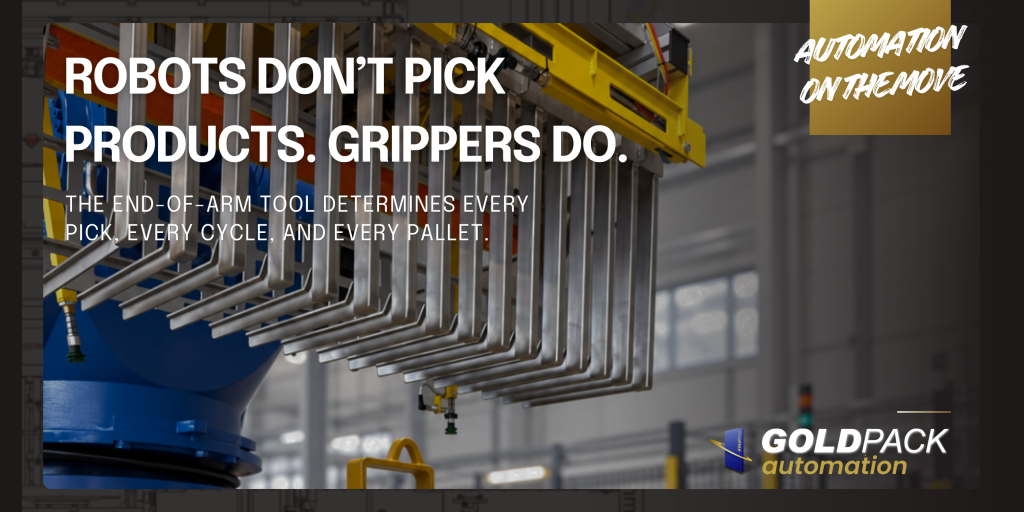
The robot moves. The gripper makes contact.
A robot may have the reach, payload and speed required on paper. But a poorly specified gripper can still cause:
- missed picks and operator interventions;
- crushed cartons, damaged bags or unstable pallet layers;
- slow robot motion caused by excessive tool weight;
- lengthy format changes;
- production stops caused by unreliable detection or poor product retention.
A line operating at 30 pick cycles per minute completes 1.800 cycles per hour. Even a 1% pick-failure rate creates 18 failed cycles in one hour – before the time required to recover the product, reset the cell and restart production.
Start with the real package – not a drawing
The first question should not be: Which robot should we use?
It should be: What exactly must the gripper handle, under real production conditions?
That means evaluating more than a product’s stated dimensions and weight. A robust gripper design needs to account for:
- actual package weight, including the heaviest permitted variant;
- centre of gravity and load stability;
- surface quality: dust, moisture, seams, holes, labels or porous cardboard;
- allowable compression or deformation;
- product presentation at the infeed;
- required pallet pattern and placement accuracy;
- current and future SKU range;
- environmental conditions, including hygiene, temperature and contamination.
A carton that looks identical in a CAD model may behave very differently on a production line after a supplier change, humidity shift or minor packaging redesign. The right solution is designed around the full operating range, not only the ideal sample.
Different products need different gripping principles
There is no universally “best” robotic gripper. The right principle depends on the package, the line speed and the level of flexibility required.
Vacuum and area grippers are often effective for cartons and other products with suitable surfaces. They can offer fast pick-and-place performance and, with properly designed vacuum zones, can handle some format variation. But material porosity, cut-outs, dusty surfaces and leakage must be evaluated properly.
Mechanical grippers use clamps, fingers or side-contact elements. They can be a strong option where vacuum is unsuitable, especially for irregular, porous or open products. The engineering challenge is to apply enough force for a secure hold without marking or deforming the packaging.
Fork and support grippers lift from underneath rather than relying only on surface contact. They are useful where product geometry, stability or load weight requires additional support.
Custom or hybrid grippers combine principles for complex applications: different packaging formats, mixed product flows, pallet layers, slip sheets or changing product dimensions.
Throughput is a trade-off, not a catalogue number
A larger gripper may lift more products in one movement and reduce the number of picks per pallet. But it also adds weight and inertia to the robot arm, which can limit acceleration and slow the cycle.
A smaller gripper may move faster, but it may require more picks.
The best answer comes from analysing the complete cycle:
- product arrives at the pick point;
- gripper positions and secures the load;
- product presence is verified;
- robot accelerates, moves and decelerates;
- product is placed accurately;
- gripper releases and returns for the next cycle.
The relevant metric is not the robot’s theoretical maximum speed. It is the sustained, verified output of the complete cell.
Reliability requires sensing, maintenance and safe failure modes
A good gripper does not only pick a product. It confirms that it has picked it correctly.
Depending on the application, that can include product-presence sensing, vacuum monitoring, position feedback and fault handling logic. The goal is to identify an incomplete or unstable pick before it creates a damaged load, a pallet pattern error or an unexpected stop downstream.
Gripper maintenance matters too. Worn suction cups, damaged seals, leaking pneumatic connections and misaligned contact surfaces can gradually reduce reliability long before a full failure occurs.
Safety must also be engineered at cell level. ISO 10218-2:2025 sets safety requirements for industrial robot applications and robot cells. A gripper is a moving, load-carrying component of that cell, so risks such as loss of vacuum, dropped product or unexpected motion must be considered in the overall assessment.
The right gripper makes automation flexible
Robotic automation is increasingly important in food and beverage, where the IFR recorded 20.792 food-industry robot installations in 2024, up roughly 42% from the previous year. But the value is not in adding a robot for its own sake.
It is in creating a packaging line that handles product variation reliably, maintains pallet quality, supports future formats and keeps the end of line from becoming the constraint on the rest of production.
The robot provides movement.
The gripper determines whether that movement becomes a reliable process.
Autonomous mobile robots, or AMRs, have moved from “interesting pilot project” to an increasingly established part of warehouse and manufacturing operations for exactly this reason. They don’t fix everything, but they solve a specific, recurring set of problems better than almost any other tool on the floor. Here are three of the most common ones, and what actually changes when an AMR fleet takes them on.

 English
  Slovenian
  Croatian
  Serbian