
3 Common Material Handling Challenges That AMRs Can Solve
Most material handling problems don’t show up as one big crisis. They show up as a forklift waiting at a dock for ten minutes, a picker walking an extra lap around the warehouse, a shift that’s short two people again. None of it looks dramatic on its own. Added up over a year, it’s the difference between a facility that hits its numbers and one that’s constantly catching up.
Autonomous mobile robots, or AMRs, have moved from “interesting pilot project” to an increasingly established part of warehouse and manufacturing operations for exactly this reason. They don’t fix everything, but they solve a specific, recurring set of problems better than almost any other tool on the floor. Here are three of the most common ones, and what actually changes when an AMR fleet takes them on.
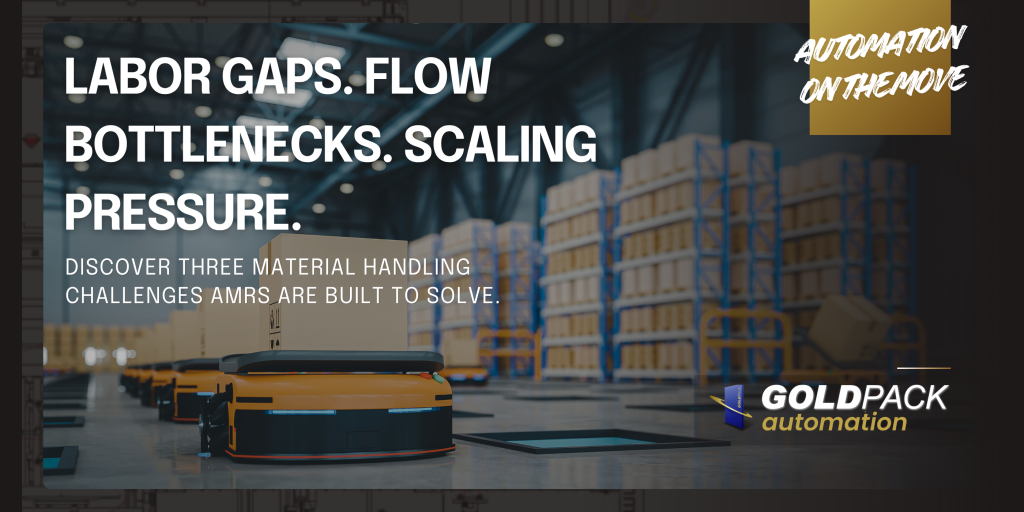
Labor shortages, turnover, and the safety risk that comes with both
Warehouse and manufacturing labor has been tight for years, putting additional pressure on companies to make better use of the workforce they already have. Repetitive transport tasks are a clear place to start. Moving pallets, materials, or components between storage, production, and shipping is essential, but it also takes employees away from activities where their skills and judgment create more value.
The safety picture adds pressure on top of that. Frequent movement of forklifts and other material handling equipment through areas shared with employees creates additional safety risks, particularly in busy production and warehouse environments. Every trip a person makes across a busy floor to move a pallet or feed a line is a small, repeated exposure to that risk.
AMRs take over exactly the tasks driving both problems: the constant back-and-forth transport of goods between storage, production, and shipping. A fleet built around units like a forklift-style mobile robot for stacking and transfer, or a conveyor-equipped unit that docks automatically with a production line, removes people from the most repetitive transport journeys on the floor.
That doesn’t mean replacing the workforce – it means the people you do have are picking, inspecting, and solving problems instead of walking pallets from A to B, which is a better use of increasingly scarce labor and can reduce employee exposure to repetitive material transport tasks and interactions with moving equipment.
Material flow bottlenecks and inflexible workflows
Fixed infrastructure is the quiet cause of a lot of material flow problems. Conveyors and rail-guided systems move goods efficiently along one path, but the moment volume shifts, a product mix changes, or a new line gets added, that fixed path can become the constraint. Changes in production volume, routing, and product mix can expose inefficiencies that were less visible when a system was first designed. Most of that shows up as exactly what floor teams already recognize: equipment waiting, congestion at pinch points, unnecessary travel, or storage that doesn’t match how goods actually move.
AMRs don’t need a fixed path. They navigate the space that’s already there, using sensors and mapping software to plan routes and reroute around obstacles or congestion as operating conditions change. That matters most in facilities with irregular layouts, under-rack storage, or narrow aisles where a conveyor or a wide industrial truck simply wouldn’t fit – this is the specific gap that low-profile, latent mobile robots are built for, since they can move underneath compatible racks and transport loads within space-constrained areas. When a production line moves, a new pickup point gets added, or a seasonal layout change comes through, routes and missions can often be reconfigured through software rather than through major physical modifications to fixed transport infrastructure.
Scaling up without a full infrastructure overhaul
The third challenge only shows up once a facility has actually solved the first two: what happens when volume grows, or a new product line needs its own material flow, or demand spikes for eight weeks a year and then drops back down? Traditional automation – conveyors, fixed racking, or transport systems designed around predefined routes and capacities – tends to lock a facility into whatever throughput and layout it was designed for. Scaling up can therefore require changes to physical infrastructure rather than simply increasing transport capacity.
Scaling an AMR fleet is closer to adding capacity than rebuilding infrastructure. Adding capacity for a busy season, a new SKU, or a second shift generally means adding units to an existing fleet and letting the fleet management software absorb them into the routing and task allocation it’s already running – rather than rerouting conveyors or restructuring a layout that was built around a different volume. That said, this is also the point where a lot of AMR projects get harder than expected, and it’s worth being honest about it: integrating a fleet with an existing warehouse management system, IT network, and power infrastructure takes real planning. Getting that integration right is essential if the system is to deliver the flexibility and scalability it was designed for.
Matching the AMR to the Material Handling Challenge
None of this is really about robots in the abstract – it’s about matching the right unit to the actual problem on your floor. That’s why our AMR range isn’t a single product: a latent mobile robot built for compact, under-rack transport solves a different problem than a forklift-style unit built for heavy stacking, and a conveyor-equipped robot that docks straight into a production line solves a different one again. Facilities in food and beverage, petrochemical, paper and wood, and similar sectors rarely have one material flow problem – they usually have two or three running at once, in different corners of the same building.
If any of the three challenges above sound like a normal Tuesday at your facility, the starting point isn’t picking a robot. It’s mapping where transport time, floor risk, and layout constraints are actually costing you, and sizing a fleet against that – not against a spec sheet. That’s the conversation we’d rather have first.

 Slovenian
  English
  Croatian
  Serbian